
Temple Emanuel - Part I
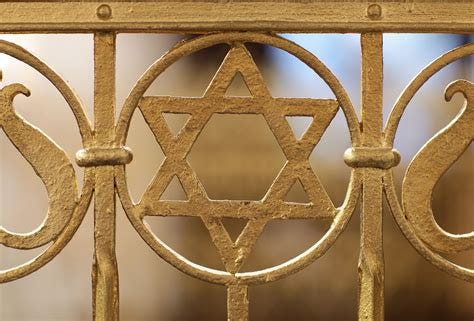
One is born Jewish no differently than one is born Black, Latin or Arabic. No choice. Meaning, many people may not identify with their ethnicity.
Example: Against my parents’ wishes, between ages five and nine, I attended children’s services at Temple Emanuel. Rosh Hashanah, Yom Kippur. Parents of two neighboring children, insisting on introducing me to my heritage, simply took me.
The effect: At age 12, on my own, again to my parents’ surprise, every Sunday, I took the bus across town to spend time preparing for my bar mitzvah at 13. Then, one week before the ceremony, one of the rabbis questioned my sincerity and threatened to thwart it. I assured him I would continue to attend temple, be part of the temple’s community. (After all that work, I would not be denied.)
Not long after my bar mitzvah, that rabbi resigned—to become a university professor. Ah, he wasn’t questioning my faith; he was questioning his. He had been among the first to enter Auschwitz at the close of World War II, and the experience still haunted him. So much that he, too, questioned his faith.
Forty years later, I finally returned to Temple Emanuel for Yom Kippur. The word “God” was barely spoken. The new rabbi knew: Don’t lose the audience. True also in Israel, where half the population is not religious. “Even puritanical John Adams thought that the argument for Christ’s divinity was an ‘awful blasphemy’ in this new enlightened age. When Hamilton was asked why the members of the Philadelphia Convention had not recognized God in the Constitution, he allegedly replied, speaking for many of his liberal colleagues, ‘We forgot.’”1
Identify or not, Jews cannot escape their heritage. With or without religion in childhood, or in their children’s childhood, parents have an obligation, as all Black parents know, no matter what they feel about their ethnicity, to prepare their children for reality.
***
Reality: Salman Rushdie, the writing staff at the satirical weekly Charlie Hebdo, and a high school teacher in France beheaded for allegedly showing his class a picture of Mohamed—no explanation. Rushdie criticized Islam; Charlie, a magazine that supported Arab rights in France, made a few jokes; the French teacher was killed by a student who was not even taking his class.
According to Bret Stephens, an opinion writer for the New York Times who wrote “The Year American Jews Woke Up,” October 9, 2024, reality is Hasidic Jews in Brooklyn being routinely shoved and sucker punched by local bullies, or Jews being jeered at by tentifada protesters on American college campuses.
Two visions of the world.
Reality, then, is frightened French school teachers treading lightly when speaking about Islam. Because anyone who speaks up is automatically a target. Think 1930s Germany, where citizens kept silent instead of acknowledging what the Nazis were doing. If asked to point to where a Jew lived, they did. “Anne Frank? She’s up there!”
Learn More from My Current My books:
Gordon S. Wood, The Radicalism of the American Revolution (Vintage, 1991), 330.